What are Micro, Small and Medium Enterprises......?
The following slabs have been prescribed under the MSMED Act to determine the status of the Enterprise:
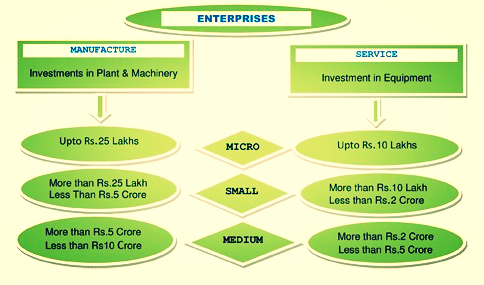
Micro, Small and Medium scale units should seek registration with the Director of Industries of the concerned State Government.
Registering your MSME Unit
The main purpose of Registration is to maintain statistics and maintain a roll of such units for the purposes of providing incentives and support services. States have generally adopted the uniform registration procedures as per the guidelines. However, there may be some modifications done by States. It must be noted that small industries is basically a state subject. States use the same registration scheme for implementing their own policies. .
Objectives of the Registration Scheme
They are summarised as follows:
- To enumerate and maintain a roll of small industries to which the package of incentives and support are targeted.
- To provide a certificate enabling the units to avail statutory benefits mainly in terms of protection.
- To serve the purpose of collection of statistics.
- To create nodal centres at the Centre, State and District levels to promote MSME.
Features Of the Scheme
-
Two types of registration are done in all States. First a provisional registration certificate is given. And after commencement of production, a permanent registration certificate is given.
- PRC is normally valid for 2 years and permanent registration is given in perpetuity.
Provisional Registration Certificate (PRC)
- This is given for the pre-operative period and enables the units to obtain the term loans and working capital from financial institutions/banks under priority sector lending.
- Obtain facilities for accommodation, land, other approvals etc.
- Obtain various necessary NOCs and clearances from regulatory bodies such as Pollution Control Board, Labour Regulations etc
Permanent Registration Certificate
Enables the unit to get the following incentives/concessions:
- Income-Tax exemption and Sales Tax exemption as per State Govt. Policy.
- Incentives and concessions in power tariff etc.
- Price and purchase preference for goods produced.
- Availability of raw material depending on existing policy.
- Permanent registration of tiny units should be renewed after 5 years.
The registration under Micro, Small and Medium Enterprises Development (MSMED) Act, 2006 is for facilitating the promotion and development and enhancing the competitiveness of Micro, Small and Medium enterprises.
Which are the classes of enterprises that may qualify for Registration ?
All classes of enterprises, whether Proprietorship, Hindu undivided family, Association of persons, Co-operative society, Partnership firm, Company or Undertaking, by whatever name called can apply for the registration and get qualified for the benefits provided under the Act. Printing of MSMED Registration/EM Number on the letter heads, invoices etc.
The Micro and Small Enterprises should mention/get printed on their letter heads, supply order sheets, invoices, bills and other relevant documents, the MSMED Registration/Entrepreneurs Memorandum (EM) Number allotted by a competent authority, so that there remains an identification of being a MSE supplier
Benefits of SSI / MSME Registration
The registration scheme has no statutory basis. Units would normally get registered to avail some benefits, incentives or support given either by the Central or State Govt. Benefits available under the MSMED Act Registration of Micro, Small and Medium (MSM) Enterprises under MSMED Act is a very powerful medium to enjoy the regime of incentives offered by the Centre generally contains the following:
Benifits for MSME :
- Easy finance availability from Banks, without collateral requirement
- Protection against delay in payment from Buyers and right of interest on delayed payment
- Preference in procuring Government tenders,
- Stamp duty and Octroi benefits,
- Concession in electricity bills
- Reservation policies to manufacturing / production sector enterprises
- Time-bound resolution of disputes with Buyers through conciliation and arbitration
- Reimbursement of ISO Certification Expenses
- Credit prescription (Priority sector lending), differential rates of interest etc.
- Excise Exemption Scheme
- Exemption under Direct Tax Laws.
- Stamp duty and Octroi benefits,
- Statutory support such as reservation and the Interest on Delayed Payments Act.
- Subsidy on ISO Certifications
- Subsidy on NSIC Preformance and Credit ratings
- Participation in Govt Purchase registrations
- Regsiattion with NSIC
- Counter Guarantee from Govt of India through CGSTI
- Waiver in Earnest Money (Security Deposit ) in Govt tenders
- Stamp duty and Octroi benefits,
- 15% weightage in price Preference.
- Reduction in rate of Interest from banks (Subject to ratings)
- Free of Cost Govt tenders
- The Buyers have to ensure whether those suppliers of goods and services are under the purview of MSMED Act i.e. the Buyers have to confirm the registration of the suppliers under the MSMED Act.
- The Buyer should ensure the payment before the end of credit period decided else the interest would be payable.
- In case of disputes, application to Micro and Small Enterprises Facilitation Council (MSEFC) would trigger the conciliation and arbitration process. Once the application is done under MSEFC, there is no provision to withdraw the proceedings. Therefore, the Buyer should ensure the best ways to resolve the disputes, if any, instead approaching to MSEFC in the initial stages of dispute.
- The Micro and Small Enterprises should mention/get printed on their letter heads, supply order sheets, invoices, bills and other relevant documents, the MSMED Registration/Entrepreneurs Memorandum (EM) Number allotted by a competent authority, so that there remains an identification of being a MSE supplier.
"CLCSS Subsidy Scheme"
- Under CLCSS scheme SME's can avail subsidy up to 15% of the Loan taken in purchasing a New Machine.
- So If an SME buys a Machine worth Rs 1.25 crore and takes Rs 1 crore loan on that, then it is eligible to receive up to Rs.15 Lac back as a subsidy from Central Govt.
- The upper limit of the subsidy is 15 lacs and is subject to fulfillment of all the criteria and requirements of the scheme.
NSIC Registration :: National Small Industries Corporation :: (GP Registrtaion)
We provide consultancy services for Small Scale Industry to registered with NSIC and get benefits for Earnest Money Deposit (EMD) - Security Deposit, Raw material Loan, exempted, Tender fee waiver, etc...
Benefits of NSIC Registration (Single Point Registration Scheme (SPRS)
The units registered under Single Point Registration Scheme of NSIC are eligible to get the benefits under “Public Procurement Policy for Micro & Small Enterprises (MSEs) Order 2012” as notified by the Government of India, Ministry of Micro Small & Medium Enterprises, New Delhi vide Gazette Notification dated 26.03.2012.
- Issue of the Tender Sets free of cost.
- Exemption from payment of Earnest Money Deposit (EMD),
In tender participating MSEs quoting price within price band of L1+15 per cent shall also be
allowed to supply a portion upto 20% of requirement by bringing down their price to L1 Price
where L1 is non MSEs.
NSIC Registration Eligibility
- All Micro & Small Enterprises which are registered with the Director of Industries (DI)/District Industries Centre (DIC) as manufacturing/service enterprises or having Acknowledgement of Entrepreneurs Memorandum (EM Part-II) are eligible for registration with NSIC under its Single Point Registration Scheme (SPRS).
- Micro & Small Enterprises who have already commenced their commercial production but not completed one year of existence. The Provisional Registration Certificate can be issued to such Micro & Small Enterprises under Single Point Registration scheme with monitory limit of Rs. 5.00 Lacs which shall be valid for the period of one year only from the date of issue after levying the registration fee and obtaining the requisite documents.
"What is Term Loan ? "
Term Loans for the Construction of Building, Office or acquisition of Machinery & Equipment including expansion and modernization of existing units.
"What is Interest Subsidy ?"
Under Interest Subsidy scheme of State Governments Eligible SME’s can get upto 5 % Interest back on their interest payments to banks.
The Interest rebate can go up to 7% if certain conditions are fulfilled.
What is a Working Capital Loan?
A Working Capital loan is a loan for Micro, Small and Medium Enterprises to cover the Working Capital cycle as well as meet the daily operational costs.
